Feeling overwhelmed with the flurry of new healthcare information being published every day? Not sure how you can stay on top of all the new research? Fear not! The library is here to help.
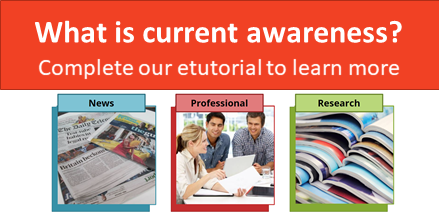
What is Current Awareness?
Why do you need to stay up-to-date? Not sure whether it
applies to you? Over the lifetime of your career you’ll need to make sure you
get the latest information that will affect your work, career and patients.
Whether it’s being aware of the latest healthcare news, staying up-to-date with
your professional responsibilities or keeping track of the latest research in
your speciality.
Complete our Current
Awareness tutorial to learn more.
KnowledgeShare from the Library
You can sign up to our KnowledgeShare bulletin service to receive
the latest high-level evidence, such as guidelines, reviews and reports,
straight to your inbox.

Complete
our registration form to let us know your specialist or professional
interests and we’ll set up your profile. Watch the video for a short overview.
Bulletins
We offer you a number of specialist bulletins, providing you
with a snap-shot of published material from a number of key healthcare
organisations.
Clinical Effectiveness Bulletin
Produced for primary care staff in Staffordshire. This aims
to draw attention to key documents, guidance and evidence-based reviews on
clinical effectiveness.
Health Inequalities Bulletin
Produced for primary care staff in Staffordshire. This aims
to draw attention to key documents, guidance and evidence-based reviews on
health inequalities.
Mental Health & Social Care Current Awareness Bulletin
Produced by the Essex Public Health Resource Unit Library on
behalf of the East of England Health Libraries Group (EoEHLG). This highlights
the latest evidence published in the following specialist areas: social work **
anxiety ** dementia ** depression ** dual diagnosis ** eating disorders **
learning disabilities ** O/C disorders ** occupational therapy **
post-traumatic stress ** psychology ** schizophrenia.
Please contact our
NHS Outreach Team if you want to sign-up to these bulletins.
Covid-19 Evidence Bulletin
Latest research published on coronavirus / covid-19. Please
contact Mathew, the clinical effectiveness librarian if you want to sign-up to
receive this bulletin directly.
Ask us
If you are looking
for a bulletin on a particular topic, we’ll investigate for you to check what
is available. Just
get in touch.
Journal eToCs
Do you have a favourite journal you like to read, or is
there a key title you want to stay up-to-date with? Then you need eToCs to make
sure you don’t miss an issue. Learn more about eToCs from my blog post – Using
Journal eToCs to stay up-to-date.
Database Alerts
To get the latest published research on a specific topic
that you are interested – for example for your dissertation or research
project, then take a look at creating databases alerts. You’ll need to create a
search strategy on a bibliographic database, then set an alert so that you are
notified when new items are added that match your search criteria. Talk to our
training team and they’ll help you to set up an alert.
Social Media
You can use social to stay in touch with the Library. We
post information about library changes as well as information about healthcare resources
and latest news articles.
Follow the Health
Library on Twitter :: Find us on Facebook.
Use Current Awareness Tools
Need a reminder of the current awareness tools available –
you can always do a quick review via our Current
Awareness Tools tutorial.

More help
If you ever need any help finding the right information – contact the
Health Library, we’re here to help.
Comments
Post a Comment