Search for an Author on Library Search #AcBookWeek

It is Academic Book Week this week – do you want to read books by our academic staff? Why not check whether we have their books in our collection?

Use Library Search to search for book titles by a particular author.

1. You’ll find a link to Library Search on the Health Library homepage. Click the Library Search option.
screen-shot of library homepage

2. Click the option "Search Books and more" to focus your search on book titles.

screen-shot of Library Search

3. You can just type the authors name into the search box.
screen-shot of an example author search
The results are presented in a list.
screen-shot of example search results

4. If you need to focus your search further, use the Advanced Search option. 
screen-shot showing the advanced search option

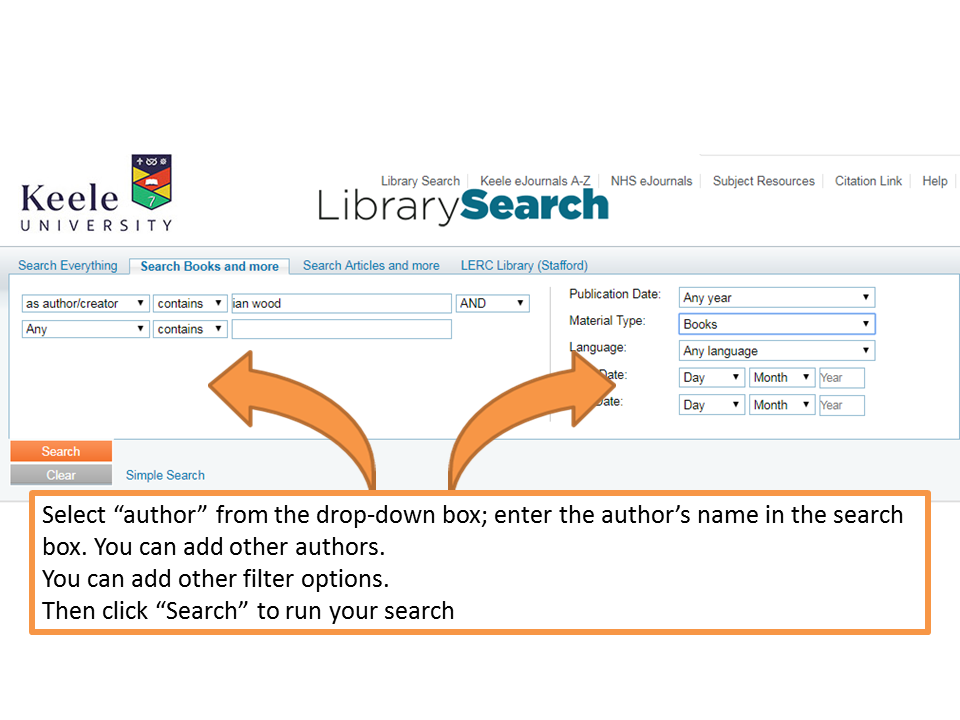
5. Select to search by author and enter the author’s name or part of their name. You can enter more than one name. Use the other filter options if you want to.
Advanced search options

6. Your search results are then presented and you can browse the items available. If needed you can use more filters to focus the results.
screen-shot of search results

Here I have selected to filter by subject.
Screen-shot of filter options
This will reduce the search results to only items indexed against these subjects.
screen-shot of filtered results

7. Don’t forget that you can submit a request if you would like the item saved for you.


Comments

Popular posts from this blog

Change your life - read this book

 With so many life-enhancing books promising life-long happiness, it is a wonder so many of us are so miserable. We have an entire collection to help you find your inner peace even if it is just for half an hour. Check our Reading Well collection for stories, journeys, poetry and self-help titles. We have 3 new titles to share: Rapport: the four ways to read people by Emily Alison & Laurence Alison "Get what you want from even the most difficult characters. Rapport reveals that every interaction follows four styles- Control (the lion), Capitulate (the mouse), Confront (the Tyrannosaur) and Co-operate (the monkey). As soon as you understand these styles and your own goals you can shape any conversation at will. And you'll be closer to the real secret- how to create instant rapport." The Courage to be disliked: how to free yourself, change your life and achieve real happiness by Ichiro Kishimi and Fumitake Koga "The Japanese phenomenon that teaches us the simple y...

New resource - Renal Drug Database for UHNM staff

 The Renal Drug Database is now available to all UHNM staff! What is the Renal Drug Database? The Renal Drug Database is an online drug reference tool providing additional drug detail relevant to renal patients, on renal dialysis or with kidney transplants. Each of the over 900 monographs provides guidance on Clinical Use, Dose in Normal Renal Function, Dose in Renal Impairment, Important Drug Interactions, Metabolism and Administration, with information validated under the governance of the UK Renal Pharmacy Group. How do you access the Renal Drug Database? You will need an individual username and password to access this resource. Note it is not an NHS OpenAthens authenticated resource. Request your username / password either by completing our online form or contacting librarian Cheryl at the Health Library c.kent@keele.ac.uk. Link directly to the Renal Drug Database or via the link on our NHS Resources page . Key Features RDD has a simple search interface to enter the drug you ...

Help the NHS understand how you access evidence - complete the survey

  NHS staff - Your help is required to build understanding of needs for access to evidence in the NHS. The national team for Knowledge and Library Services are researching how NHS staff currently access and use evidence. We have completed interviews with people from all parts of the team and in all settings across the NHS in England. The next phase of the research will seek to validate the needs that have been identified as a result. We want to understand the picture for clinical and non-clinical staff, students and apprentices, those in regular contact with their Knowledge and Library Service and those who are not. You can read about previous user research that informed the creation of the Knowledge and Library Hub and be assured that your input can make the difference. If you can help, please complete this brief survey The survey will close 12 April 2026